
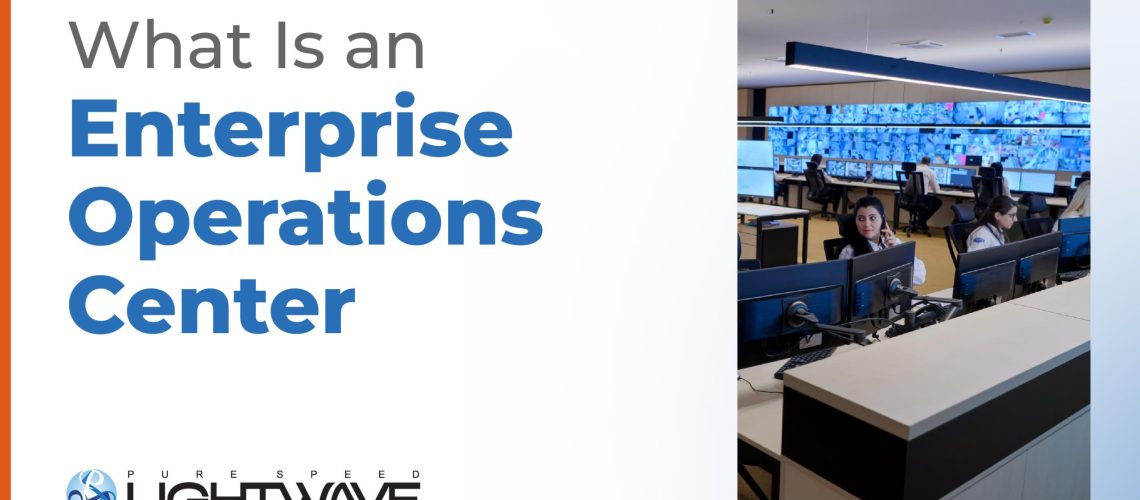
When everything depends on your network (your apps, your calls, and frankly, your entire business), you don’t want to find out something’s broken the hard way.
That’s why some companies don’t just hope their systems stay up. They have a plan. And that plan starts with a place built to keep everything online all the time.
It’s called a Network Operations Center. And in the enterprise world, it’s not just helpful. It’s a vital support system.
And today, we’re going to talk about it.
The Definition of a Network Operations Center (NOC)

A Network Operations Center (NOC) is a physical (or sometimes virtual) location where trained technicians monitor and manage the health of your network performance in real-time. They keep your systems healthy, secure, and fast without requiring your internal team to babysit them.
In an enterprise setup, the scale gets bigger, and the stakes get higher. That’s where an enterprise Network Operations Center steps in. Think of it like a typical NOC, but much larger. An enterprise NOC handles large, complex network systems that support hundreds or thousands of users across different locations.
In short, a NOC is your always-on, always-alert IT pit crew.
So, what happens inside a NOC, day in and day out?
Great question! Here’s what’s going on behind the screens at an enterprise NOC:
- Real-time network infrastructure monitoring to catch network disruptions like outages, traffic spikes, or suspicious activity
- Incident response and troubleshooting before end users even know there’s an issue
- Security alerts and early detection of cyber threats
- Ongoing system updates and patching to keep things running smooth
- Performance optimization based on usage trends and metrics
- Custom reporting so businesses can make smart, data-backed decisions
The goal? Keep everything working, and when something goes wrong, fix it fast. For companies that depend on uptime, this kind of dedicated attention is absolutely invaluable. And here’s why.
Why Your Enterprise Needs a NOC (Even If Things Seem Fine)

Even the most well-built networks can fail. It’s a hard pill to swallow, but it’s true. Hardware can fail, software can glitch, and cyber threats are constantly looming. Maybe your VoIP traffic starts dropping calls, or your cloud apps go dark. Maybe someone slips through your firewall.
If no one’s watching your network, those problems can easily spiral into full-blown disasters that cost you far more than you think.
That is why cost effective, 24/7 network support matters. With trained eyes on the network around the clock, issues get spotted early and fixed fast, often before anyone notices something’s wrong.
Support from Seasoned NOC Engineers gets you:
- Fewer outages because issues are caught and fixed in a timely manner
- Better uptime so employees stay productive and customers stay happy
- Stronger security with constant surveillance for odd or dangerous behavior
- Faster recovery when things go wrong
- Less stress for your in-house IT team members
And in industries like healthcare, finance, energy, and logistics (where a 10-minute outage can cost thousands), these benefits add up fast.
Now, some of you may be wondering, “Why can’t I just use my internal IT team to do this?” Well, yes, but most in-house IT teams already have plenty on their plate. Adding 24/7 monitoring to the mix? It’ll stretch resources thin and make it harder to stay ahead.
A dedicated NOC takes that pressure off your plate. It gives your team breathing room to plan, improve, and innovate instead of living in crisis mode.
Local Support vs. Remote NOC Support: Which is Better?

That depends on what matters to your business. A lot of communication service providers use outsourced NOC services or overseas support desks. That setup might save them money, but it can also mean slower response times, less personalized help, and a whole lot more phone tag.
What’s different about local NOC support?
- Faster fixes when something goes sideways
- Clear communication with people who speak your language and know your environment
- Real accountability from a team who works down the road, not across the globe
- Support that scales with your business and your network, not just a static checklist
When something breaks, the last thing you want is to start from scratch with someone halfway across the world. You want a dedicated team of NOC technicians who already knows your network, your region, and what’s at stake.
That’s the power of local NOC support. And it’s exactly what you get with PS Lightwave’s Houston-based NOC: real people, close by, ready to step in fast with the know-how to fix your organization’s network infrastructure.
Frequently Asked Questions (FAQ) about NOC Services

Still have questions about the network support that an NOC team can provide? No problem. We answer some of the most common (and some uncommon) ones below.
Is a NOC the same as a help desk?
No. A help desk helps the people using the network troubleshoot everyday issues. A NOC watches (and manages) the network infrastructure itself. Think of the NOC as system-focused, while the helpdesk is more user-focused.
Do I need a NOC if I already have an IT team?
Yes. A NOC doesn’t replace your IT team. It supports them. It handles the day-to-day monitoring and response work so your internal staff can focus on higher-level projects.
Can a NOC prevent outages or cyberattacks entirely?
Not completely. In fact, no system can promise zero downtime or perfect network security. But a good NOC, like PS Lightwave’s, can catch problems early, respond fast, and minimize the damage. Whether it’s an outage or a potential threat, early detection makes all the difference.
How do I know if I already have NOC coverage?
If your current provider says they offer “managed services” or “network support,” ask them who monitors your network connectivity after hours to keep your business running smoothly. If they can’t give a straight answer, you might not have true NOC coverage.
What if the NOC itself goes down, like during a power outage or hurricane?
Good enterprise NOCs like PS Lightwave’s are built to handle that. They have backup power, redundant connections, and emergency plans to keep network performance issues to a minimum. In places like Houston, where major storms are part of life, having a local team who knows the risks and how to respond quickly makes all the difference.
What if I’m using third-party applications or a hybrid cloud setup?
The NOC can monitor performance across physical infrastructure and virtual environments, including cloud-based platforms, as long as it has access and visibility.
How quickly can NOC services be deployed?
It depends on the size and complexity of your network, but onboarding is usually pretty straightforward. Local managed service providers like PS Lightwave work closely with clients to get everything configured, tested, and deployed as smoothly as possible.
Can a NOC handle cloud networks, too?
Absolutely. Most modern NOCs, including PS Lightwave’s, are built to monitor both physical infrastructure and cloud-based environments.
Is everything automated?
Automation helps, but humans are still the backbone. At PS Lightwave, real people watch over your network, investigate alerts, and make the final call on critical actions.
Is NOC support expensive?
It’s not cheap, but outages aren’t either. A single hour of network downtime can cost thousands in lost revenue, especially in healthcare, finance, or logistics. NOC services pay for themselves in the downtime they prevent.
To Sum Up, Your Business Deserves an NOC (Especially One That’s Close to Home)

You can’t afford to gamble with network connectivity. And you don’t have to settle for a faceless support queue or a call center on the other side of the world.
With PS Lightwave’s Enterprise Network Operations Center, you get responsive, real-world support from real people who know how to keep your network strong, steady, and secure.
Looking for better uptime, faster support, and a partner who knows what’s at stake?
Talk to PS Lightwave today.
